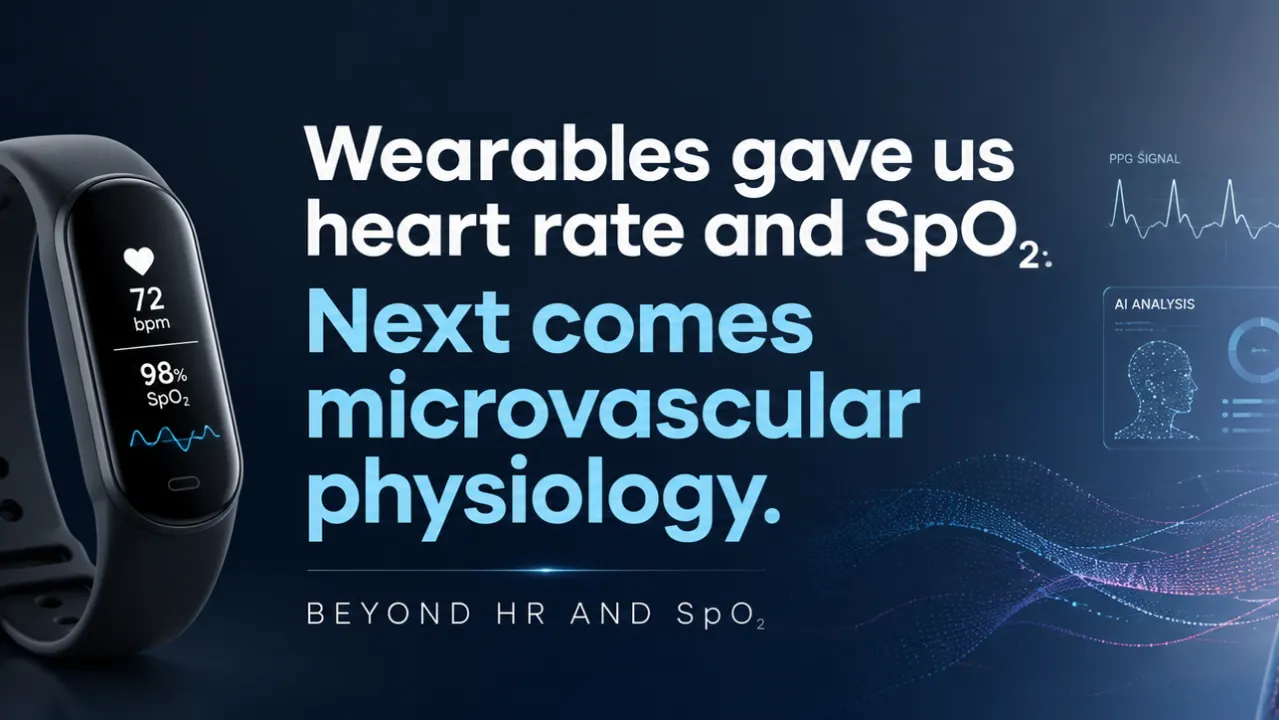
For years, wearables have given us more heart rate, more SpO₂, more sleep scores, and more dashboards.
That was a good start.
But I think the next phase will be much bigger.
The real opportunity in wearables is not just measuring more signals. It is understanding more physiology.
And that next layer of physiology may come from the microvascular world.
Heart rate tells us how fast the pump is moving. SpO₂ tells us how much oxygen is carried.
But neither fully tells us a deeper question:
Is tissue actually being served well?
That is where microvascular physiology becomes interesting.
For a long time, this was hard to access outside hospitals and research labs. The technology was simply not mature enough for passive, large-scale, continuous sensing. That is now changing. New low-cost wearables are becoming lighter, screenless, more passive, and much easier to wear 24/7. Google’s newly launched Fitbit Air is a good example: a $99.99, screenless tracker built for continuous health monitoring, paired with the Google Health app and Google Health Coach.
This matters more than people realize.
When a wearable becomes cheap enough, simple enough, and comfortable enough for mass adoption, it stops being just a gadget. It starts becoming a data layer for human physiology. Google openly frames Fitbit Air around 24/7 monitoring and ties it to an AI coach designed to generate more personalized guidance. Google has also said users can connect medical records to Fitbit so the coaching becomes more personalized and context-aware.
This is where things get exciting.
Because once low-cost wearables start collecting passive physiological data at scale, AI will not just summarize yesterday’s numbers. AI will start asking new questions from the signal itself.
Not only:
What was your heart rate? How long did you sleep? Was your SpO₂ normal?
But also:
How did your vascular system respond to stress this week? Is your recovery changing at the tissue level before symptoms appear? Are your hydration, inflammation, autonomic balance, or vascular aging patterns shifting over time? Is there a signal hidden inside this optical data that medicine has not operationalized yet?
That is a very different future.
For years, we used wearable sensors mainly to recreate old vital signs in a prettier format. We took a rich optical signal and asked it to give us familiar outputs: heart rate, oxygen saturation, step count, calorie estimates.
But PPG and related optical sensing may contain much more than that. Recent work in major journals is starting to show exactly why. A 2025 Communications Medicine paper described AI-derived PPG age as a scalable digital biomarker for cardiovascular health and showed that a larger PPG age gap was associated with substantially higher cardiovascular risk. (Nature)
Another 2025 Nature Communications paper showed that a wearable-based PpgAge was associated not just with chronological age, but also with chronic disease, incident heart disease, metabolic disease, and behavioral factors such as sleep, exercise, and smoking. It also showed sensitivity to longitudinal physiological changes. (Nature)
This is exactly why I believe the field is shifting.
The hardware side is getting cheaper.
The sensing side is getting better.
The AI layer is getting smarter.
And the science is finally catching up.
A 2026 Nature Medicine paper on the All of Us wearables dataset described it as one of the largest wearables datasets available for biomedical research, linking wearable data with genomics, electronic health records, and survey data to advance digital biomarkers and their clinical applications. That is a major signal that wearable science is moving from hype toward population-scale evidence. (Nature)
So what happens next?
I think people will start asking for more from wearables.
Not just: “what is my HR?” or “how was my sleep?”
But: “what is happening to my physiology?” “what is changing before I feel it?” “how is my tissue-level health adapting over time?” “can AI find patterns in my vascular responses that matter for aging, recovery, inflammation, or resilience?”
That is where microvascular vitals may become a thing.
Not as a single magic number. Not as a replacement for clinical judgment. And not as an excuse to overclaim.
But as a new class of candidate digital biomarkers built from continuous, passive, real-world physiological data.
That, to me, is the most exciting part.
We are moving into an era where AI may generate new candidate biomarkers much faster than traditional medicine ever could. Some of those signals will fail. Some will be noise. But some will prove meaningful, reproducible, and clinically useful. And once they do, we may look back and realize that wearables were never just about counting steps or checking heart rate.
They were the first scalable window into human microvascular physiology.
For years, wearables gave us more heart rate and SpO₂.
The next phase may give us something much more valuable:
a deeper, more dynamic, and more personal understanding of human physiology itself.
Exciting time to be alive.
You finished · 4 min read
Originally published on LinkedIn by Dr Yudara Kularathne MD, FAMS(EM).