
Yesterday, I wrote about the risk side of healthcare data — the possibility that we may soon have a digital twin of ourselves sitting inside Google servers. That conversation is important because healthcare data is probably the most sensitive data we have. But today, I want to talk about the other side.
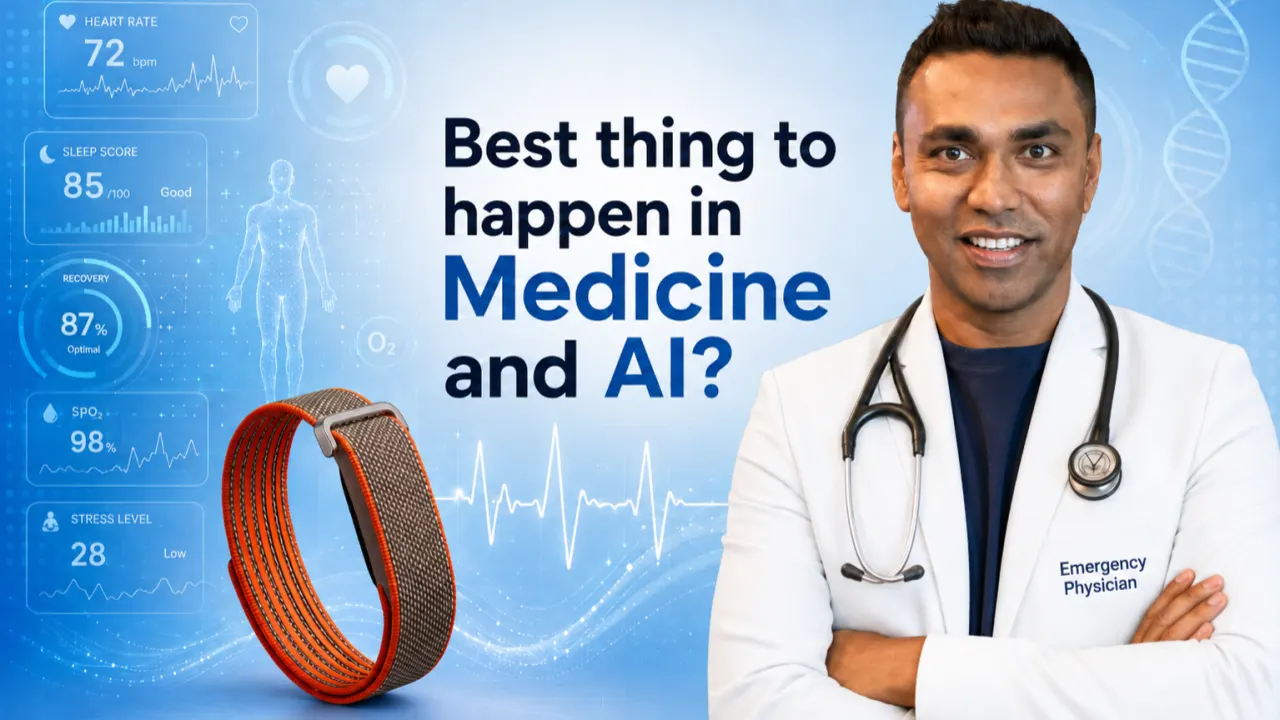
To me, Fitbit (now part of Google) Air connecting with Google Health Coach may be one of the biggest things to happen in health and AI so far in 2026. Not because it is just another wearable. Not because it gives another sleep score, heart rate graph, or step count. But because AI is finally moving from passive tracking to active physiological understanding.
Google has launched Fitbit Air as a lightweight, screenless wearable, while Google Health Coach is built with Gemini to give personalized insights across fitness, sleep, recovery, and wellbeing. The Fitbit app is also becoming Google Health, turning it into a more centralized health platform. As an emergency physician, this is fascinating to me.
In the resus room as a ER doctor, we often do not have the luxury of long stories. Patients are too sick. Sometimes they cannot talk. Sometimes the history is limited, confused, emotional, or simply unavailable. So we read physiology.
We look at heart rate, blood pressure, respiratory rate, perfusion, temperature, oxygen saturation, and conscious level. I used to tell my medical students that in resus, I do not care about the perfect textbook history first. I care about whether the physiology is preserved.
Diagnosis is important, of course. But in emergency medicine, my first priority is simple: protect physiology and keep the human alive.
I know the general public may not fully understand this mentality. Emergency physicians often think in patterns of physiological collapse before we think in neat disease labels. Now imagine putting that same physiology-first mindset into an AI health agent.
Google already has Fitbit, a huge wearable ecosystem with tens of millions of active users and more than 100 million devices sold over time. With cheaper and simpler wearables like Fitbit Air, the entry barrier becomes lower. More people will wear it, and more people will generate continuous physiology data.
Now connect that to Gemini and medical AI models. This is where things become very powerful.
The AI is not just looking at one user in isolation. It can learn from population-level physiological patterns and then apply those insights back to the individual. That is the magic: population-level learning with individual-level guidance.
I have been using Google Health Coach for more than two weeks now, and my honest personal impression as a doctor is: mind-blowing. And we should remember something very important. The worst AI health coach we will ever see is the one we are seeing today. It will only get better from here.
I will give a few examples. I was chatting with Google Health Coach about my hydration, and it gave me some interesting insights. This week, it also noticed that my resting heart rate over the last two weeks had dropped significantly compared with before. I had also shared that I was trying a new night routine, including a small volume of electrolytes before sleep.
It connected those dots.
Honestly, I had not even thought that this intervention might be directly related. Of course, many other things can affect resting heart rate — sleep, stress, training, recovery, alcohol, illness, hydration, and emotional state. But that is exactly the point. It was connecting dots.
Another example: it noticed that my heart rate was high on two occasions even though I was not exercising. It could see that my movement was low, but my heart rate stayed elevated for a sustained period. So it flagged it and basically asked, “You were not moving, but your heart rate was high. What was happening?”
In my case, I was in a courtroom for a very personal matter, and I was emotionally overdriven. But it also asked me to consider things like dehydration and hyperthyroidism, because the rhythm looked regular — not atrial fibrillation, but more likely sinus tachycardia.
Look at that connection. Movement data, heart rate, rhythm pattern, context, follow-up questions, and differential thinking.
This is not a doctor yet. It is not replacing clinical care. But it is starting to behave like a health companion that notices physiology and asks better questions. That is a big shift.
Soon, wearables will officially start telling us more about blood pressure. My lab Hii.Health is also working on core inflammation signals using wearable data, and we are working on digital dehydration biomarkers too. Now imagine all of this coming into an AI agent.
It may be able to notice early infection before you feel very sick. It may detect worsening dehydration where your performance gets affected. when sustained blood pressure elevated to you, you might be having undiagnosed Hypertension. Even conditions like undiagnosed diabetes may eventually show indirect signals through dehydration, diuresis, changes in recovery, heart rate, sleep, energy, and other patterns. Soon it can even tell you how fast you are aging and why.
This is where health becomes continuous.
Not one blood test once a year. Not one clinic visit after symptoms become bad. But daily physiology, interpreted intelligently.
A doctor sitting next to you all the time is impossible. But a physiological agent watching trends, asking questions, and guiding you before things collapse? That is becoming real.
Of course, the risk side still matters. Google says Fitbit health and wellness data will not be used for Google Ads, but users still need to understand what they are consenting to, what data is being shared, and how deeply this technology can map their lives.
So my take-home message is simple: adopt the technology, but know what you are doing.
For me, as an emergency physician who is crazy about physiology, this feels like the beginning of a golden age in personal health. We are moving from wearables that count steps to agents that understand physiology and telling you what to do.
That is a very big deal.
You finished · 4 min read
Originally published on LinkedIn by Dr Yudara Kularathne MD, FAMS(EM).